
Raven's heart
Common Raven / Corps / Common Raven
Raven's heart
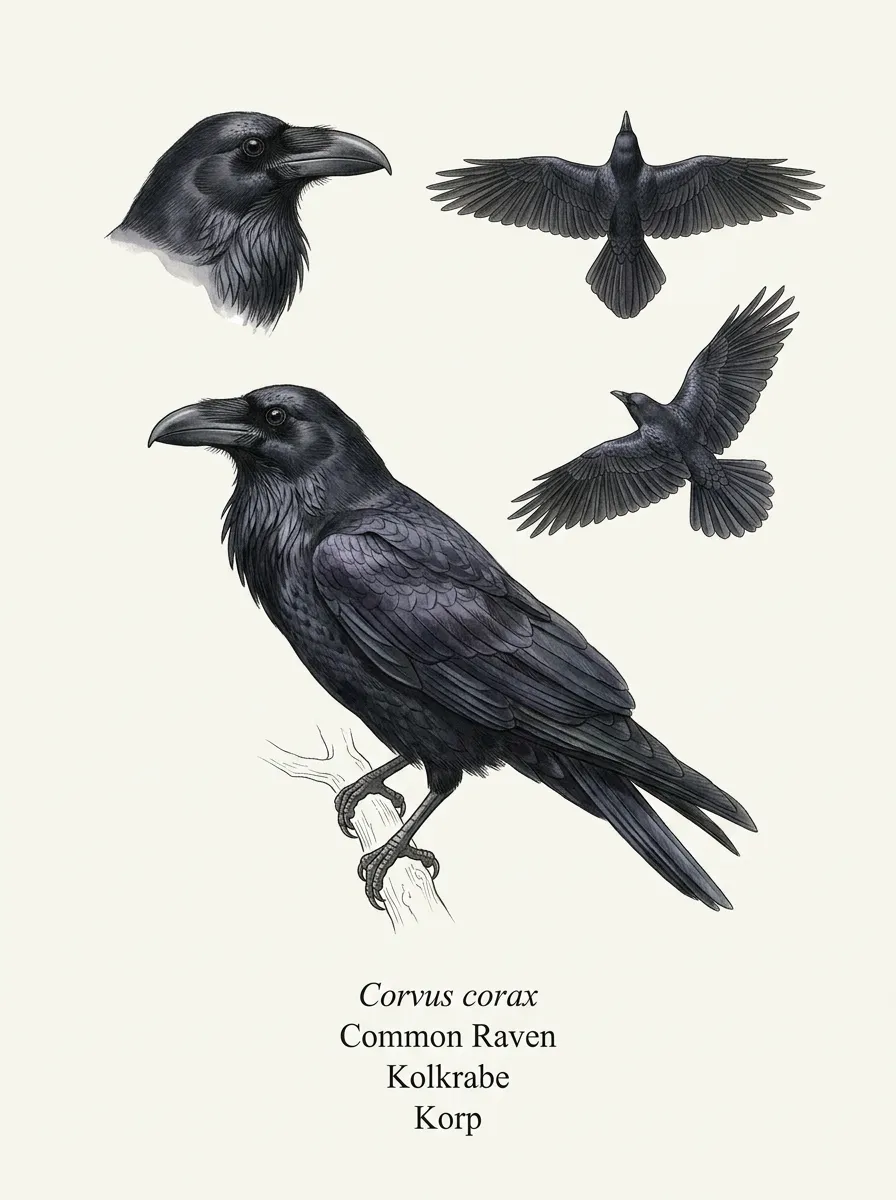
Illustration: Corvus corax
- Plumage: Entirely jet-black plumage with a deep metallic violet, steel-blue, and greenish iridescence under direct light. - Beak: Massive, heavy black bill with a strongly curved culmen and stiff nasal bristles covering the upper half. - Body build: Largest passerine bird in the world, robust build with long broad wings (wingspan 115–130 cm) and strong legs. - Distinctive details: Elongated, pointed hackle feathers on the throat puffed out during calling, distinctly wedge-shaped (diamond) tail profile in flight.
This species is an important part of the ecosystems in Västerbotten.
Facts & Characteristics
- Scientific Name: Corvus corax
- Category / Order: Vögel (Aves)
- Nature, Taiga & Waters of Västerbotten: Nature, Taiga & Waters of Västerbotten
- Native to Northern Sweden: Native to Northern Sweden
Questions & Answers (FAQ)
What makes the Common raven one of the most adaptable birds in Fennoscandia?
Its highly opportunistic and omnivorous diet, combined with exceptional intelligence and problem-solving skills, allows it to thrive in both boreal coniferous forests and the alpine tundra.
What role does it play in the food web of the boreal ecosystem?
It acts as a significant scavenger, quickly locating and clearing animal carcasses. It often follows large predators like wolves or wolverines to feed on their kills.