
Myodes rufocanus
Arctic Bank Vole / Gråsiding / Gray Red-backed Vole
Myodes rufocanus
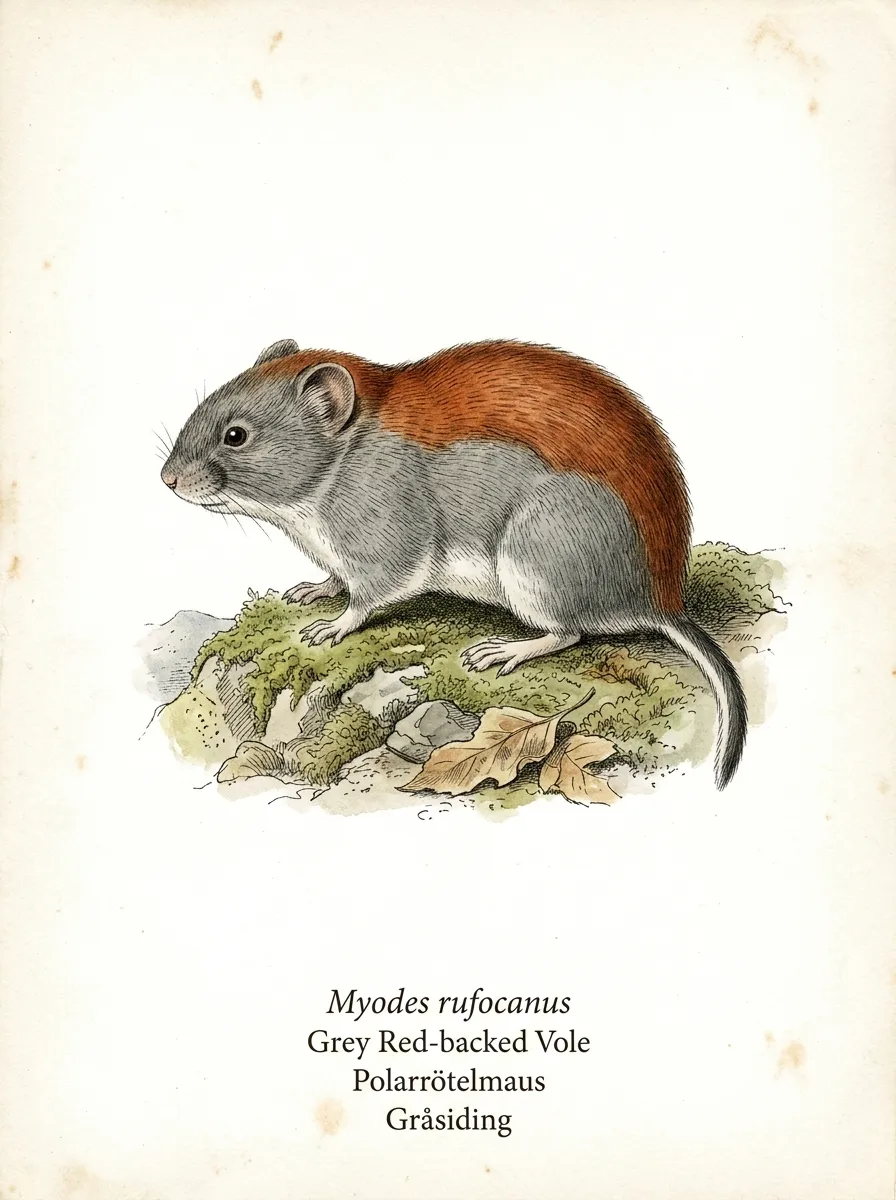
Illustration: Myodes rufocanus
The grey red-backed vole (Myodes rufocanus) is a characteristic inhabitant of the Nordic fell taiga and tundra, known for its distinct reddish back and grey flanks. It is a major herbivore whose population dynamics have profound effects on the local flora.
In the boreal and subalpine zones of Scandinavia, this vole forms a fundamental basis of the food web. Its three- to five-year population cycles dictate the population trends of numerous predators, from owls to foxes.
Facts & Characteristics
- Scientific Name: Myodes rufocanus
- Category / Order: Säugetiere (Mammalia)
- Nature, Taiga & Waters of Västerbotten: Nature, Taiga & Waters of Västerbotten
- Native to Northern Sweden: Native to Northern Sweden
Questions & Answers (FAQ)
How does Myodes rufocanus influence plant communities in the fell taiga?
As a dominant herbivore of the Scandinavian forest tundra and taiga, the grey red-backed vole consumes enormous amounts of dwarf shrubs (e.g., Vaccinium myrtillus) during cyclical peak years. This leads to periodic rejuvenation of the vegetation and shifts competition in favor of mosses and grasses, which in turn modulates the soil microclimate.
What role do they play in the trophic network of Fennoscandia?
They are essential prey for specialized predators such as the least weasel (Mustela nivalis) and the Boreal owl (Aegolius funereus). Their cyclical population fluctuations (3-5 years) dictate the reproductive rates of these predators and drive the 'Alternative Prey Hypothesis,' where foxes switch to grouse in years with low vole numbers.