
A timid rabbit
Mountain Hare / Skogshare / Mountain Hare
A timid rabbit
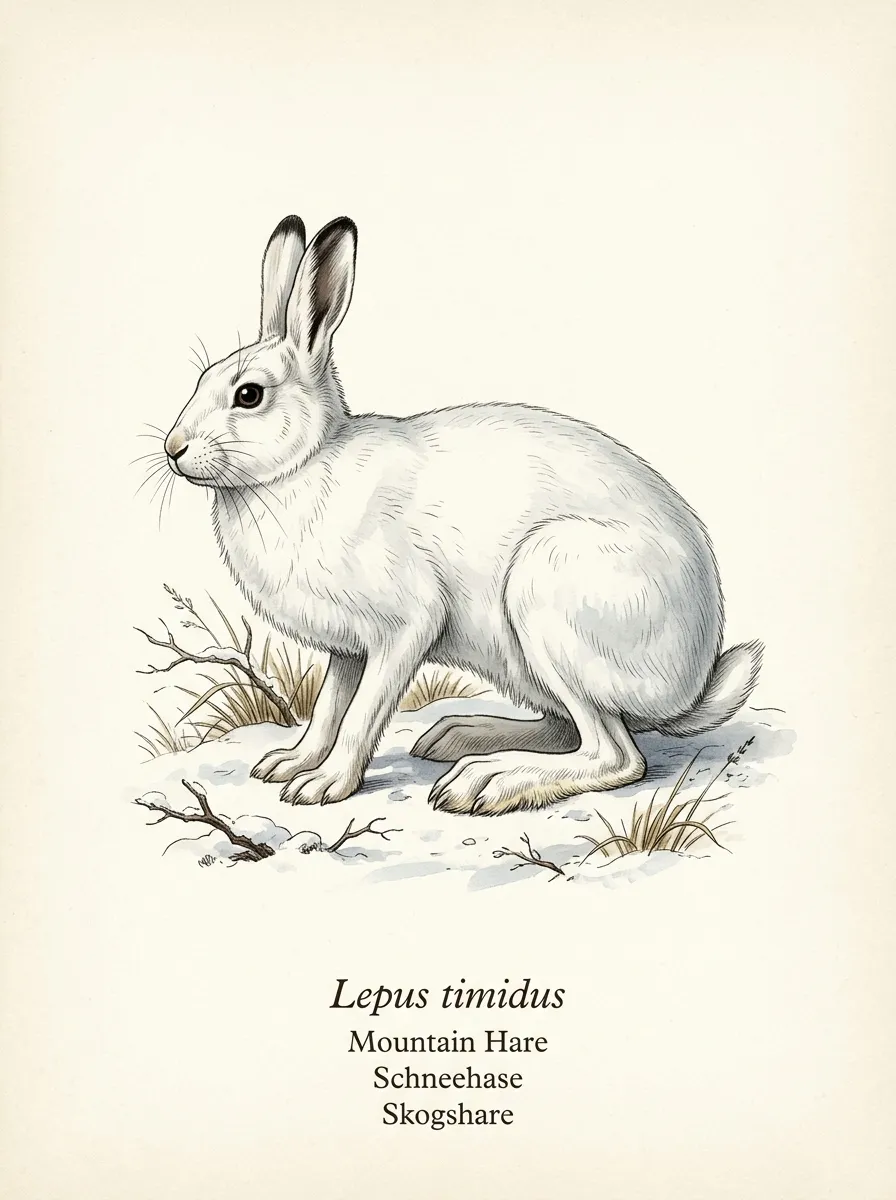
Illustration: A timid rabbit
The mountain hare (Lepus timidus) is perfectly adapted to the boreal and subarctic environments of Scandinavia, notably through its seasonal coat change from brown to snow-white. It prefers bog margins, sparse pine forests, and the shrub layer of the subalpine zone.
As a major prey species for lynx and foxes, its demography influences predator density in the taiga. However, climate change and the associated reduction in snow cover now pose a significant threat to its crypsis and survival.
Facts & Characteristics
- Scientific Name: Lepus timidus
- Category / Order: Säugetiere (Mammalia)
- Nature, Taiga & Waters of Västerbotten: Nature, Taiga & Waters of Västerbotten
- Native to Northern Sweden: Native to Northern Sweden
Questions & Answers (FAQ)
How is Lepus timidus adapted to the extreme winter conditions of the boreal and alpine zones?
The mountain hare undergoes a seasonal molt to a dense, white winter coat, which serves as perfect camouflage and insulation (crypsis). Phenotypically enlarged hind paws act as snowshoes, reducing surface pressure and allowing energy-efficient movement on soft, fresh snow.
What is the significance of the mountain hare for Scandinavian predator communities?
In the boreal forest zone, it is a central prey for Eurasian lynx (Lynx lynx), red foxes, and golden eagles. While the population dynamics of the mountain hare are less cyclically pronounced than in North America, they still significantly modulate the density and hunting success of large and medium-sized predators during snowy winters.