
Tetrao urogallus
Capercaillie / Tjäder / Western Capercaillie
Tetrao urogallus
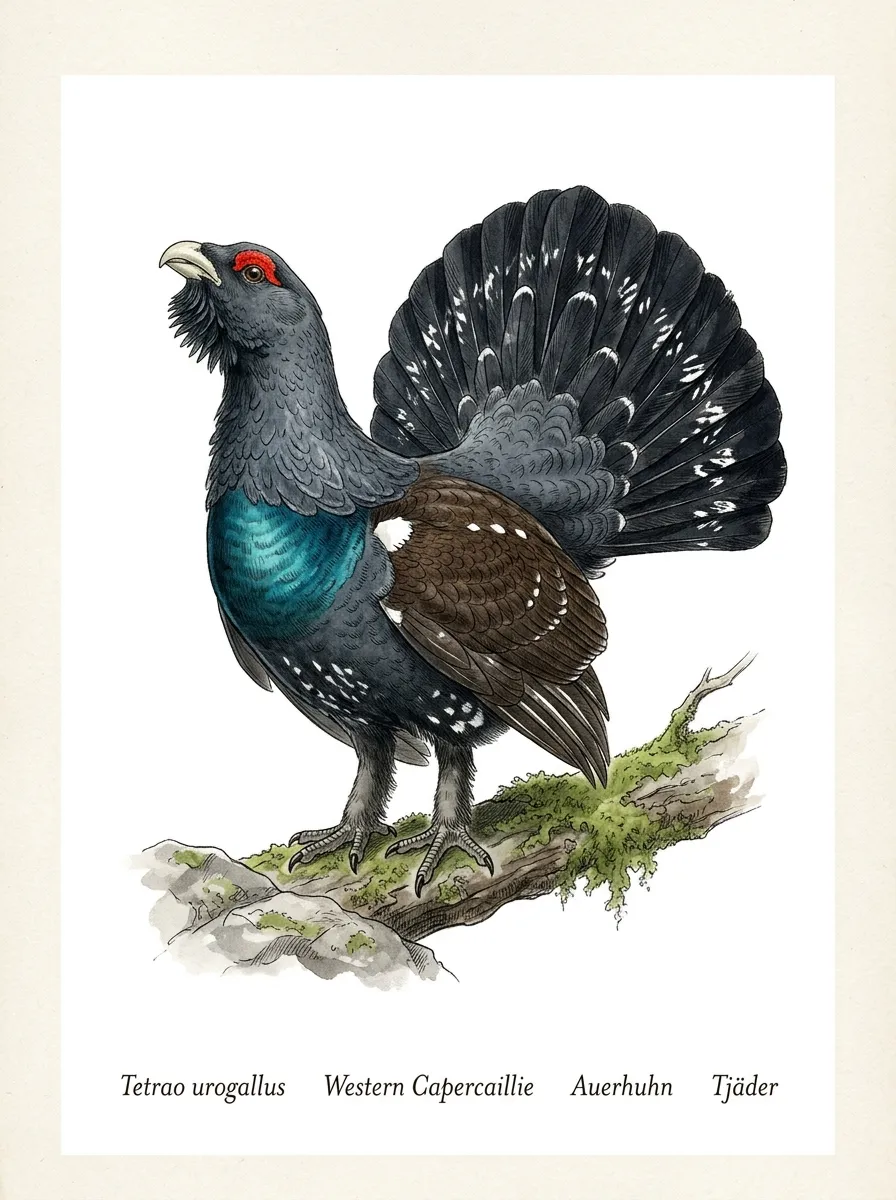
Illustration: Tetrao urogallus
- Plumage: Male mostly dark slate-grey with metallic blue-green breast shield, dark brown wings with white carpal spots, broad black tail flecked white. - Beak: Massive, heavy, pale ivory-horn coloured curved bill. - Body build: Enormous, heavy forest gamebird (male weight up to 4.5–5 kg) with a broad fan-like tail and sturdy legs. - Distinctive details: Bright scarlet-red bare skin crest (rose) above the eye, tufted beard feathers on chin, heavily feathered toes with comb-like pectinations.
The capercaillie is a symbol of intact pine forests in Scandinavia. In winter, it feeds almost exclusively on pine needles, a unique adaptation to the boreal cold.
Facts & Characteristics
- Scientific Name: Tetrao urogallus
- Category / Order: Vögel (Aves)
- Nature, Taiga & Waters of Västerbotten: Nature, Taiga & Waters of Västerbotten
- Native to Northern Sweden: Native to Northern Sweden
Questions & Answers (FAQ)
What is the capercaillie?
The western capercaillie (Tetrao urogallus) is the largest member of the grouse family in Europe, known for the striking courtship displays of males in spring.
Where does this species live?
It inhabits extensive, undisturbed coniferous forests (taiga) with a rich understory of dwarf shrubs (blueberries) and old pine stands.