
Perisorius is unfortunate
Unlucky Jay / Lavskrika / Siberian Jay
Perisorius is unfortunate
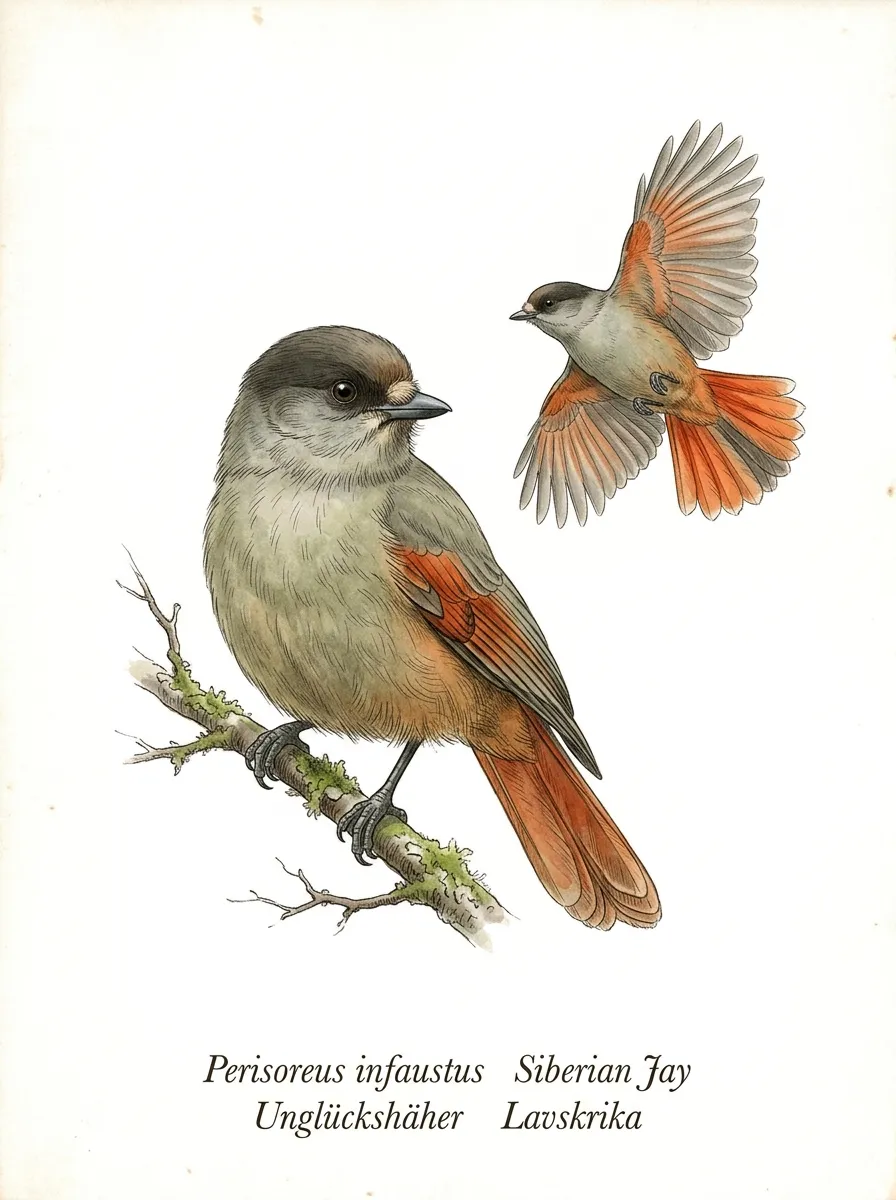
Illustration: Perisoreus unlucky
- Plumage: Soft grayish-olive body with striking rusty-orange/reddish tail feathers, wing coverts, and rump; dark greyish-brown head cap. - Beak: Short, straight, dark grey bill with nostrils covered by dense tufts of soft grey feathers. - Body build: Compact medium-sized corvid (length 26–31 cm) with fluffy insulation plumage and a moderately long tail. - Distinctive details: Bright reddish-orange outer tail feathers clearly visible during flight, dark brown cap extending down to eye level.
This species is an important part of the ecosystems in Västerbotten.
Facts & Characteristics
- Scientific Name: Perisoreus infaustus
- Category / Order: Vögel (Aves)
- Nature, Taiga & Waters of Västerbotten: Nature, Taiga & Waters of Västerbotten
- Native to Northern Sweden: Native to Northern Sweden
Questions & Answers (FAQ)
Why is the Siberian jay considered a key indicator species of boreal old-growth forests?
It requires a dense canopy and lichen-rich, undisturbed old-growth forests to hide its winter food caches. Its presence correlates strongly with intact forest structures and coarse woody debris.
How does it survive the harsh Scandinavian winters?
It hoards food (berries, seeds, carrion) during summer and autumn, hiding it under bark and in tree lichens such as Alectoria and Bryoria for winter sustenance.